
How to Create a Short Link with a Country Redirect
Learn how to create a short link with a country redirect using clear country rules, destination URLs, and a safe fallback.
In questa pagina
How to Create a Short Link with a Country Redirect
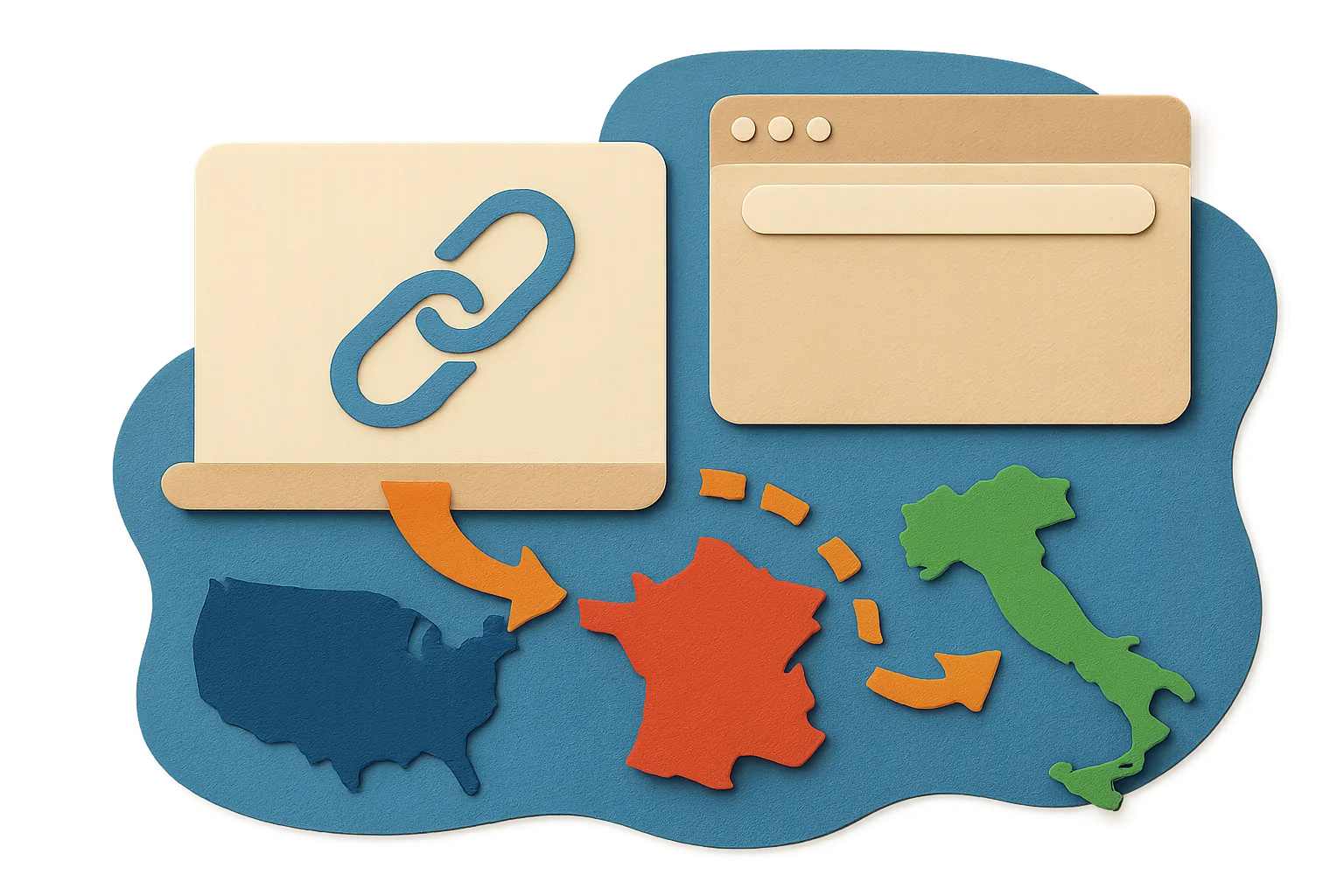
A country redirect sounds simple on paper. One short link, different landing pages, and each visitor lands on the page that fits their country. In practice, the details matter because one wrong country rule can send real traffic to the wrong offer, the wrong language, or the wrong form.
This guide shows how to create a short link with a country redirect in a way that stays tidy from the start. The pattern is straightforward: decide the use case, prepare the destination URLs, build the short link in urlik.xyz, then add country rules and a fallback destination. No guesswork.
1. Define the exact country-routing use case
Start with one short link and one decision: should the visitor see a country-specific destination or not? That sounds obvious, yet teams often try to make the first link handle every market at once. Bad idea. A single campaign link for France, Germany, and Canada is manageable; a global maze of 20 destinations is not.
Country redirects work best when the visitor experience truly depends on location. A retailer may want one page for Germany, another for France, and a default page for everyone else. A SaaS company may need a country redirect only for pricing pages, legal pages, or language-specific sign-up flows. Keep the scope tight. One link. One decision path.
If the campaign needs to support multiple countries with the same language, a country redirect can still be useful. For example, a single English page might work for the US, UK, and Australia, while Canada gets a separate version because of taxes or local terms. That saves you from maintaining three separate links in ads, emails, and QR codes.
2. Gather your country-specific destination URLs
Before you touch the short link, collect every destination URL you plan to use. The country redirect is only as clean as the pages behind it. If the French page still says “coming soon,” the redirect is premature. If the German page is blocked by a login wall, the redirect will only hide the problem for a second.
Each country page should be public, complete, and ready for traffic. Check the title, the language, the currency, and the form fields. A visitor from Spain should not land on an English checkout page with a EUR symbol and a US phone field. That mismatch hurts trust fast.
Use this checklist for each destination:
- One public URL for each country or region.
- Local language or at least local wording.
- Correct currency, shipping, or legal text where needed.
- No staging banner, no test password, no placeholder copy.
Some teams only need region-level pages. For example, the same destination can serve Belgium, the Netherlands, and Luxembourg if the content is genuinely suitable for all three. If that is your setup, keep the URL list short and simple. A country redirect does not need to become a geography lesson.
3. Create the base short link in urlik.xyz
Create the base short link first, before any country rule is added. That gives you one stable link to manage and test. In urlik.xyz, start by entering the main destination or the default landing page, then generate the short link. This gives you a working link even before the country routing is finished.
Work from the default page outward. If something goes wrong later, you still have a valid short link that leads somewhere safe. That matters when a campaign is already scheduled or a QR code has been printed. Nobody wants to replace a poster because the routing logic was half-finished on launch day.
If your campaign uses a branded setup, pair the country redirect with a custom short link domain so the link looks consistent in ads, email, and social posts. The domain choice does not change the routing logic, but it does change trust. People notice the link before they notice the destination.
Keep the base link readable and tied to the campaign. A messy internal slug makes later testing harder. A clear short link is easier to copy, easier to share, and easier to audit when a country rule needs a quick correction.
4. Add country redirect rules to the link
Now map each country to the correct destination URL. The structure is simple: country A goes to page A, country B goes to page B, and so on. If the platform lets you group countries into a region-level redirect, use that only when the region truly shares one destination. A rule for “North America” sounds neat, but it can create a bad user experience if Canada and the US need different pages.
Enter the countries carefully. A single mis-typed country code can send the wrong audience to the wrong page. That becomes a support issue later, not just a setup issue. Double-check the exact country names or codes used by urlik.xyz, and confirm that the destination URL beside each one is the correct live page.
For example, a campaign might map:
- France to a French product page.
- Germany to a German checkout page.
- Spain to a Spanish pricing page.
- All remaining countries to a default landing page.
If your campaign has only 2 or 3 relevant markets, do not add 15 unnecessary rules. Keep the rule set small. The more rules you add, the more likely someone will forget why one was created. That is how routing tables become folklore.
5. Set a fallback destination for unmatched visitors
Every country redirect needs a fallback destination. Not every visitor can be matched cleanly, and not every visitor’s country will be included in your rule set. Some users arrive from countries you did not plan for. Others arrive through networks that make country detection uncertain. A fallback gives them a safe place to land instead of a dead end.
Choose a page that can handle uncertainty. A global home page is often better than a local country page, especially if it includes language selection, currency guidance, or a clear “choose your country” link. If you send unmatched visitors to a narrow page, they may bounce immediately.
The fallback should also make business sense. If your main goal is lead capture, send unmatched visitors to the broadest form page. If your main goal is sales, send them to the most universal product page. The fallback is not a dumping ground; it is the default route for people who do not fit the map.
A quick aside: this is where many teams get lazy. They build the country rules, forget the fallback, and then wonder why traffic from a new market disappears into nowhere. One default page would have solved it.
6. Check how country detection will be interpreted
Country redirects depend on how the platform interprets location signals. That means the result is useful, but not perfect. Visitors may travel with a VPN, appear through a corporate network, or roam on mobile data, and the detected country may not match where they actually are.
That is not a bug in your link alone. It is a limitation of geographic detection. A person in Italy using a US VPN may be routed as if they are in the US. Someone on a company network in London may appear elsewhere. A traveler crossing borders by train might see a different destination at different times of the day. Short links do not read passports.
Plan for these edge cases. If the page is sensitive to location, make the destination page itself allow manual switching. If the page is less sensitive, keep the country redirect broad and forgiving. For campaigns where the routing must be especially predictable, you may want to compare country routing with 301 vs 302 redirects before you lock in your setup.
Also watch out for mobile carrier behavior. Some networks route traffic in ways that make geo-detection less precise. That does not mean country redirects are unreliable. It means they should be treated like practical routing, not absolute identity checks.
7. Test the redirect from different country signals
Test before you publish widely. A country redirect should be checked from more than one signal, because one browser test from your desk is not enough. Start with the countries you mapped, then inspect the destination, the language, and the fallback.
Use any available test traffic, browser-based location tools, or network conditions that can simulate another country. If your team has access to users in different markets, ask for a quick click test from a real device. A person in Berlin will catch a broken German page faster than any staging note will.
Here is a practical testing list:
- Open the short link from a normal connection.
- Check whether the correct country destination appears.
- Try a different network or location-aware testing tool.
- Confirm the fallback page works for unmatched traffic.
- Repeat the test after any rule change.
If you already use are short links safe? how for internal review, this is a good place to apply the same habit: test the redirect path before real traffic arrives. A country redirect can be correct in the dashboard and still fail in practice if one destination page has a blocked asset or a broken locale switcher.
Do not rely on one test only. Two or three checks from different signals are better than one confident mistake. The goal is not to prove the system in theory; the goal is to see what a visitor actually receives.
8. Publish and monitor the link after launch
Once the country redirect is tested, publish the link in the places that matter: email, paid ads, social posts, partner pages, or QR codes. The point is consistency. Everyone should use the same short link so every click is counted against the same routing logic.
After launch, watch whether the country routing is sending people to the right destinations. If one market gets far more traffic than expected, your rule set may need a revision. If a country page gets clicks but weak engagement, the page itself may need work, not the redirect. Separate routing problems from content problems early.
You can also pair the country redirect with A/B testing links if you need to compare different destination pages by market. That is useful when one country page has two versions, and you want to see which one holds attention longer. Keep the experiment clear, or the routing data becomes noisy.
Check the link again after any market change. A new region may need its own rule. A closed office may need its old country page retired. A legal update may require one country to move to a different destination URL. Country redirects are not set-and-forget. They need the same attention as the pages behind them, and the link should change when the business changes.
One final operational detail: if you share the link across channels, give the team a short note with the country rule list and the fallback page. That way, when someone asks why Spain lands on one page and Portugal on another, you do not have to reconstruct the setup from memory at 6:30 on a Friday.
Metti in pratica
Incolla un link e ottieni un URL breve, un codice QR e statistiche sui clic in pochi secondi — gratis, senza registrazione.
Di più dal blog
How to migrate from Rebrandly to Urlik
Learn how to migrate from Rebrandly to Urlik safely, preserving links, custom domains, tracking, and team workflows.
Short Link Redirects for Mobile Devices: How They Work and Why They Matter
Learn how short link redirects for mobile devices route users to apps, mobile pages, or fallbacks, and why they improve campaigns.
Why My Short Link Shows the Wrong Destination
Learn why my short link shows the wrong destination, from typos and edits to cache, app rewriting, and redirect chains.