
On this page
What A/B Testing Short Links Means
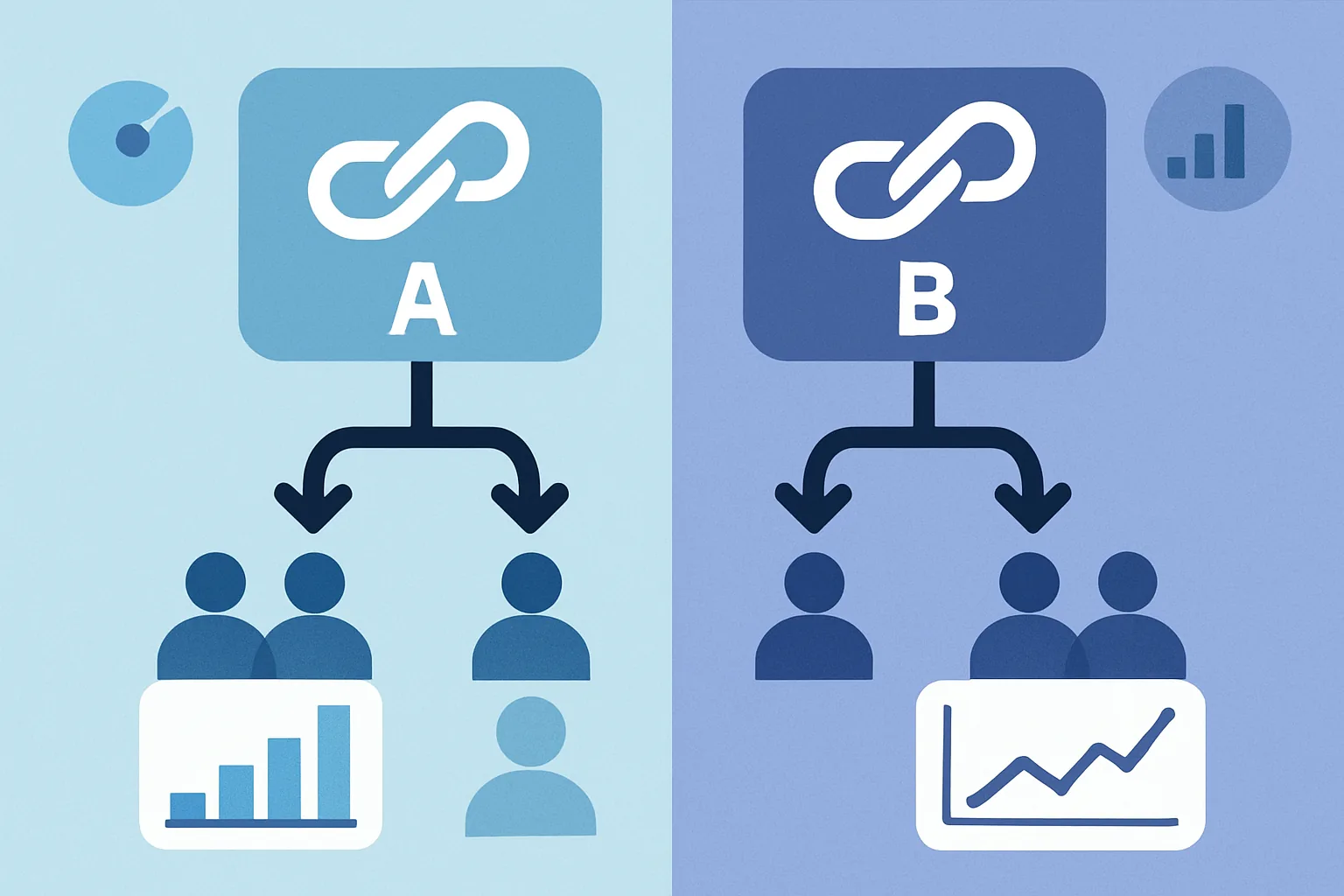
A/B testing short links is a simple idea with a very practical payoff: you create two or more link variants, send traffic to each one, and compare the results. The variants may point to different destination URLs, or they may differ in the way they are presented, tracked, or distributed across channels, and the point is not to guess which version feels better. It is to measure which version actually performs better.
That makes short-link testing a little different from broader campaign testing. In a general marketing experiment, you might compare two ad creatives, two email subject lines, or two landing pages at once. With short links, the link itself becomes part of the experiment. It can be the thing you change, the thing you track, or the thing that controls where people go, and sometimes that means testing two destinations with identical promotion. Sometimes it means testing the same destination through two different link treatments. Either way, the link is doing more than shortening a URL. It is carrying the experiment.
The basic goal is straightforward: compare two or more link variants to see which drives stronger results. “Better” can mean more clicks, more conversions, more engagement after the click, or a lower cost per outcome. The right metric depends on what you are trying to learn, and that is where many experiments go off the rails before they even begin.
Why Marketers Use Short Links for Experiments
Short links are useful in testing because they are easy to deploy across channels without making every asset feel clumsy. A long tracking URL can work in a dashboard; it is less charming in a tweet, a QR code, a printed flyer, or a text message, and a short link keeps the presentation clean while still allowing you to collect data and route traffic intentionally.
They also make version control easier. If you are experimenting with multiple destinations, you do not need to rebuild every ad or email each time. You can swap destinations behind a link, duplicate a link variant, or create a new one with a clear label and compare it against the original. That saves time, which matters when you are iterating quickly across channels. It also reduces human error. Fewer moving parts usually means fewer broken UTM strings, fewer copy-paste mistakes, and fewer “why is this link different on LinkedIn than in the newsletter?” moments.
Another advantage is speed. Marketers often want to test in the wild, not in a lab. A short-link setup lets you launch a new variant, watch the response, and adjust without waiting for a full campaign rebuild, and that is especially handy when the same audience sees your message in multiple places. If you are testing a branded link for trust and recognition, for example, a custom short link domain can keep the experience consistent while the experiment runs.
There is also a subtle psychological benefit. People are more likely to click a short, readable link than a messy one that looks like a tracking chain exploded. Clean presentation does not guarantee better performance, of course, but it removes friction. And in experiments, removing friction is often the whole game.
How to Split Traffic Between Link Variants
There are a few common ways to split traffic between two destination URLs or two link versions, and the simplest is an equal split: half the traffic goes to Variant A, half to Variant B. If your goal is a direct comparison and neither version has an obvious risk, equal allocation is usually the cleanest setup. It gives both variants a fair chance and makes the result easier to interpret.
Weighted splits are useful when you want to reduce exposure to a newer or less certain variant, and for example, you might send 80% of traffic to the current link and 20% to the new one while you check performance. That is not as statistically tidy as a 50/50 split, but it can be practical when the stakes are high or the audience is limited. Weighted splits are also common when one variant is a control and the other is a test with more uncertainty.
Randomization matters more than many teams realize, and if traffic is not assigned randomly, your results can be biased by time of day, source, or audience segment. A link that gets most of its clicks from mobile users in the evening is not directly comparable to one that is primarily clicked during weekday office hours. Your split should not silently favor one group over another.
Common setup mistakes include mixing too many variables, sending one variant to a different audience, or changing the destination while also changing the promotion, and if Variant A lives in email and Variant B lives on social, you are testing channels, not just links. That can be a valid study, but it is not the same question. Another frequent issue is forgetting to confirm that both variants are live and tracked before the campaign starts. One broken redirect can turn a neat experiment into a headache with very poor data. A quick pre-launch check is worth it. So is a second pair of eyes.
For private or controlled comparisons, teams sometimes combine short links with password-protected links so only intended recipients can access a draft, internal page, or early offer. That is not required for A/B testing, but it can be useful when you want to isolate a small audience before a wider launch.
What Link Analytics Should Track
Good link analytics go beyond raw click counts, and clicks tell you that something happened, but not enough about who clicked, when they clicked, or what they did next. At minimum, you want to know total clicks and unique clicks. Total clicks show volume. Unique clicks help you see how many individual people or devices engaged, rather than counting repeated taps from the same source.
Timing matters too. A link that gets an early burst and then flatlines may be serving a different audience than a link that grows steadily over the course of the day. Click timing can reveal patterns by campaign send time, social posting time, or paid placement. It can also help you catch anomalies. If a variant spikes at 3 a.m. from a single region, you may want to look closer before celebrating.
Device and location signals can add useful context. If one version performs much better on mobile, the issue may have less to do with the link itself and more to do with the landing page experience after the click, and likewise, if a destination works better in one region, local relevance or language may be the real driver. Referrers are equally important. A click from a newsletter, an embedded QR code, and an organic social post are not interchangeable, even if they land on the same page.
Where available, conversion tracking should be part of the picture. The click is only the start of the story. A winning link variant is not necessarily the one with the most taps; it is the one that best supports the action you care about, whether that is a signup, purchase, download, or inquiry. If your platform can pass campaign data into downstream analytics, use it. Otherwise, you are left judging by a very partial view of performance.
For marketers who care about post-click behavior, retargeting pixels on short links can also be relevant. They help connect link clicks to later audience building, which makes the experiment more than a one-time click contest, and it becomes part of a broader measurement system.
Designing a Fair A/B Test for Links
A fair test starts with one variable. That sounds obvious, but it is where a lot of experiments become impossible to read. If you change the destination page, the call to action, the audience, and the posting time all at once, you have no clear idea which change mattered. Pick one thing to test. Keep the rest steady.
Audience consistency is just as important as creative consistency. If possible, serve the same kind of traffic to each variant. If you are testing in email, send both versions to comparable segments. If you are testing in social, avoid assigning one link to a highly engaged community and the other to a colder one unless that difference is part of the hypothesis. Timing should also be aligned. Launching one variant on Monday and the other on Friday can introduce noise from weekly behavior patterns.
Avoid overlapping campaigns that could contaminate the results. If the same users encounter multiple versions through different channels, they may interact with both and blur the comparison, and that is not always avoidable, but it should be intentional if it happens. Otherwise, your “split” is not really a split at all.
Before launch, define a clear success metric. Is it click-through rate, conversion rate, engagement after click, or something else? Make the decision in advance, not after the numbers arrive. Otherwise it becomes tempting to declare the winner based on whichever metric happens to flatter the preferred variant. That is not testing. That is shopping for a conclusion.
A sensible test plan also includes a note about the hypothesis itself: what you expect to change and why. Even a short sentence helps later. “We believe a clearer CTA link will increase qualified clicks from social traffic” is more useful than “Let’s see what happens.” Curiosity is good. Ambiguity is expensive.
Reading the Results and Choosing a Winner
Once the data starts coming in, resist the urge to crown a winner too early, and a few strong clicks can look exciting, but early spikes are often misleading. A variant may appear to dominate because it was posted during a busy hour, shown to a highly responsive segment, or picked up by a single referrer. Without context, the graph can flatter almost anything.
Low sample sizes are a common trap. If only a small number of people saw each variant, the difference between them may be mostly noise, and in that case, the test may be directionally interesting but not conclusive enough to guide a real decision. That is especially true when the observed gap is small. A tiny lead from one variant does not necessarily mean it is better in a durable sense.
Look at the whole pattern, not just the final tally. Did one variant outperform consistently across the day, or did it win because of a short burst? Did the result hold across devices, referrers, or locations? Was the click advantage matched by a better conversion rate, or did the extra traffic turn out to be less qualified? Sometimes the link with fewer clicks is the better performer downstream, which is why post-click metrics matter so much.
If the data is messy, say so. It is perfectly acceptable to decide that a test was inconclusive, and that may feel unsatisfying, but it is better than making a confident choice on shaky ground. When a test is reasonably conclusive, act on it, document the outcome, and move on to the next question. The purpose of testing is not to produce a single eternal winner. It is to improve decisions over time.
Common Use Cases for A/B Testing Short Links
Short-link testing shows up in a lot of everyday marketing work, and one of the most common uses is testing CTA wording. For example, a campaign may link to the same page through two different prompts: “Get the guide” versus “See the guide.” The destination stays constant, but the framing changes, and that can reveal how much language affects engagement.
Landing page testing is another familiar case. Two links may point to different destinations that are nearly identical except for one element: a headline, form layout, offer order, or page length. Short links make it easy to direct traffic precisely and compare the results without overcomplicating the campaign asset itself.
Email placement tests can be especially useful. A link in the first paragraph may perform differently from a link lower in the message or inside a button. In newsletters, subtle layout changes sometimes matter more than flashy copy. The same is true in social posts, where link framing, surrounding text, and the timing of the post all influence performance.
Paid ads often use short links for destination testing as well, and one ad may send traffic to a product page, while another sends users to a comparison page or a lead form. The goal is not simply to get clicks; it is to see which route best supports the campaign objective. And in some industries, a cleaner link presentation can be a useful trust signal, especially if the link appears in multiple placements or offline materials.
If your content is tied to commerce or partner promotions, it may also be worth reading about affiliate link cloaking. While that topic is not the same as A/B testing, both rely on tidy, trackable links that are easier to manage and measure.
Best Practices and Pitfalls to Avoid
Good naming conventions save time later. Label each link in a way that tells you what it is testing, where it is used, and when it was launched. “Spring email CTA A” is far better than “final-link-2-new.” Six weeks later, your future self will thank you. Probably not out loud, but still.
Document the hypothesis before the test starts. Write down what you expect to happen and what would count as success. That record matters when you review the results or explain them to a teammate who was not in the room when the idea was born, and it also helps prevent hindsight from rewriting history.
Check analytics quality before relying on the data. Missing tags, duplicate redirects, broken destination URLs, and inconsistent UTM structures can all distort split-traffic results. If the measurement layer is weak, the experiment is weak. There is no shortcut around that.
Be careful with changes that seem minor but actually alter the meaning of the test. Different preview images, different button copy, or different source channels can all influence behavior in ways that have nothing to do with the short link itself. And if you are sharing links across offline materials, QR codes, or printed collateral, remember that the context around the link affects the outcome just as much as the destination. In some cases, a dynamic QR code can help you keep the destination flexible without reprinting assets, which is useful when testing evolves after launch.
Finally, do not treat every result as a universal truth. A winner in one audience may fail in another, and a link that works in email may underperform in social. A destination that converts well on desktop may feel awkward on mobile. Testing works best when it is specific, disciplined, and a little humble. That is not a flaw. It is the method.
Used well, A/B testing short links gives marketers a practical way to learn faster, clean up their tracking, and make better decisions with less guesswork. The mechanics are simple enough. The hard part is the discipline: one variable, clear measurement, and enough patience to trust the data when it is ready.
Put this into practice
Paste a link and get a short URL, a QR code and click stats in seconds — free, no sign-up.
More from the blog

What a Short Link Analytics Dashboard Is
Learn short link analytics dashboard metrics, from clicks and referrers to device and timing data, to judge campaign performance better.
What Short Link Analytics Means
Learn how short link analytics reveals clicks, devices, timing, and referrer data to measure what drives traffic and improve campaigns.

How Much Does QR Code Tracking Cost at Scale?
Learn how much does QR code tracking cost at scale, including scan volume, code counts, analytics depth, retention, and hidden ops fees.